
The intonation violinists play
A piano is tuned in equal temperament: the octave cut into twelve equal steps. A violinist does not always play that way. In a double stop the ear seeks pure intervals: a major third is played a little lower than on a piano, by about 14 cents (a cent is a hundredth of a half step). In a melody, the leading note leans up towards its tonic. Avilo judges each exercise against the reference that suits it.
- Double stops are judged against pure intervals
- In scales, a leading note or a major third played a little high, as violinists do, counts as in tune. Played as on a piano, it does too
- The other exercises are judged in equal temperament, as a tuner does, at the pitch you choose
Tolerances based on measurements
How far off is out of tune? Avilo's levels follow what researchers measured on real violinists: beginners stray about 20 cents in scales (Pardue and McPherson, 2019), professionals about 10 in very slow scales (Loosen, 1993).
| Level | Distance accepted | Notes in tune for a good series |
|---|---|---|
| Beginner | ±30 cents | 70 % |
| Intermediate | ±18 cents | 75 % |
| Advanced | ±12 cents | 80 % |
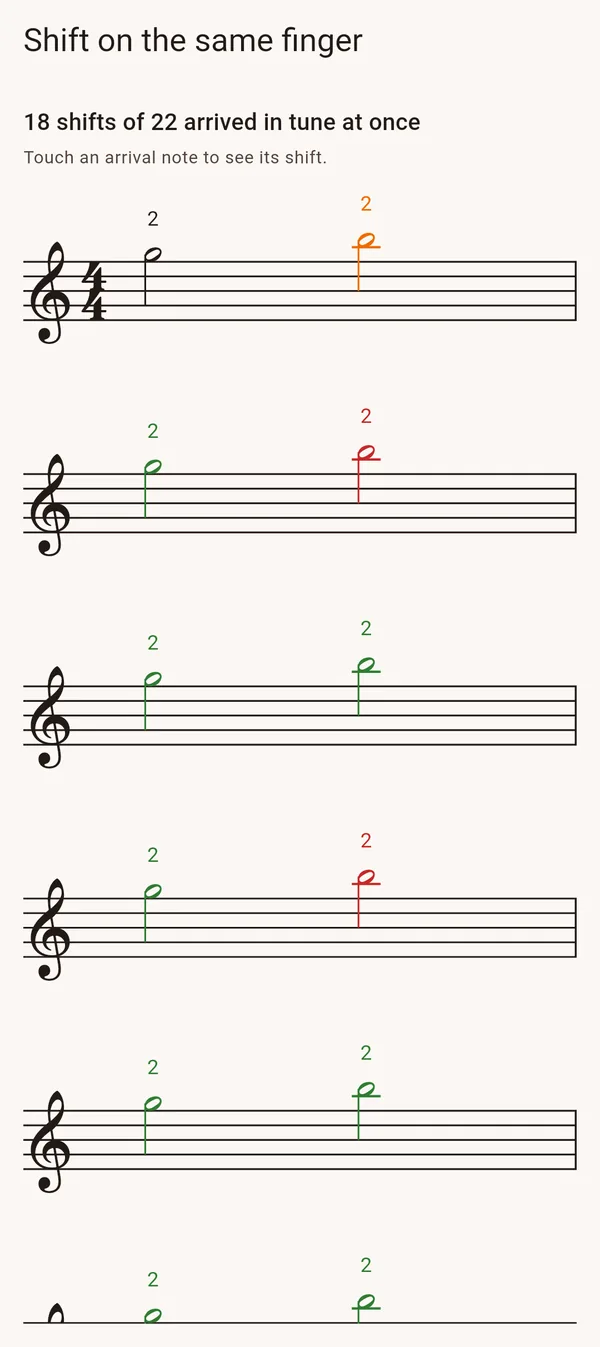
A series is good when that share of its notes is in tune. The tolerance tightens by one and a half at each level. It is one and a half times wider for the arrival note of a shift. In the exercises where rhythm is measured, the same share of notes must be in time too.
What a pitch curve tells
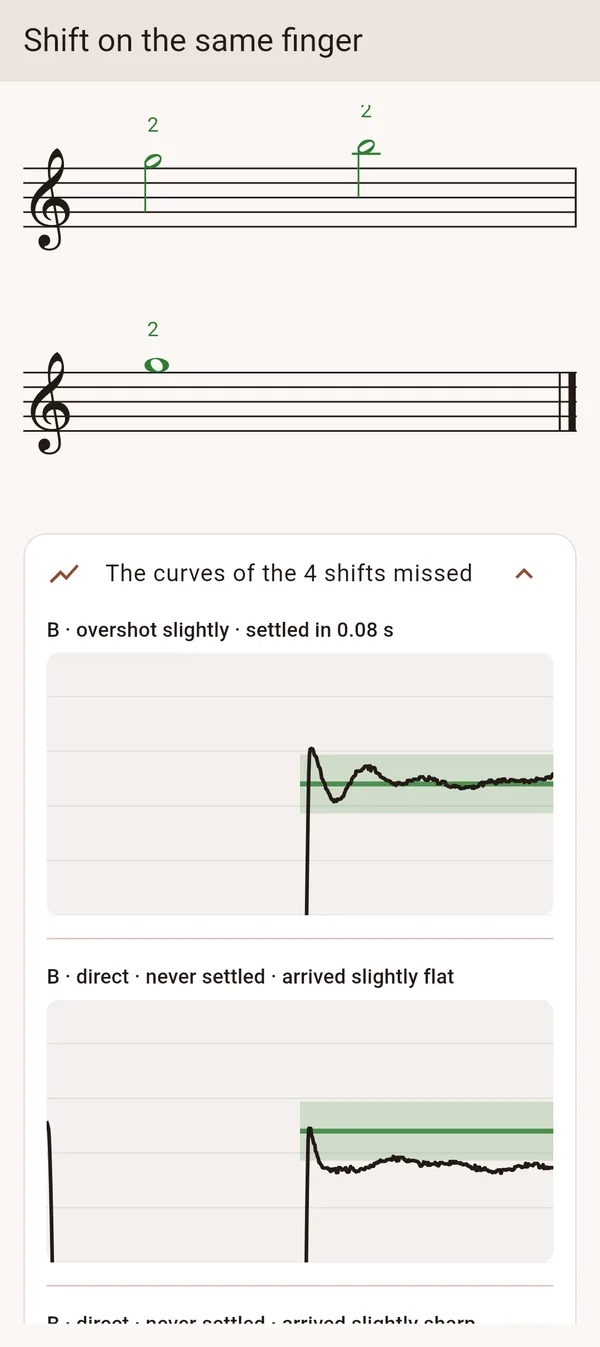
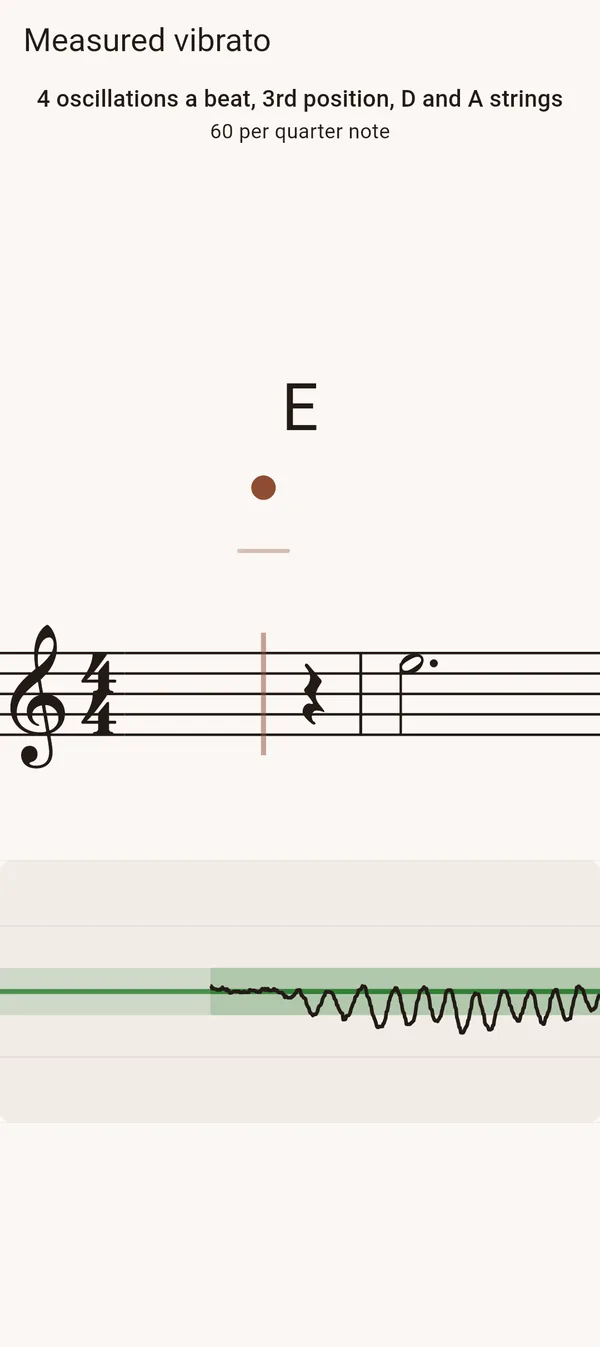
Avilo follows the pitch and the volume of your sound from the start to the end of each note. This lets it measure:
- A shift: the glide, how far it overshoots, how long it takes to settle on the note
- Vibrato: its speed in oscillations per beat and its width in cents
- Each bow stroke: even, swelling or fading, from the volume through the stroke
- Rhythm: each note ahead of or behind the beat
- Pulse: when the metronome goes silent for a few bars, whether you rush or drag, and by how much
A new series each time
Each exercise in Avilo has settings: key, string, finger, position, rhythm, bowing, tempo. Avilo changes them at each series, and you can play a series again exactly. A stage is acquired once three different series are good, each at its best try, at the level's tempo.
The violin methods behind each stage
Avilo does not reproduce the methods: its exercises follow their order and are inspired by them.
| Theme | Inspired by |
|---|---|
| Fingers | Ševčík op. 6 (the system of half steps), Schradieck book 1 |
| Scales and arpeggios | Hřímalý, Scale Studies; Flesch, Scale System (scales on one string) |
| Positions and shifts | Ševčík op. 1 and op. 8 (shifts by distance), Hřímalý, Flesch, Sitt op. 32 |
| Vibrato | Galamian, Flesch |
| Double stops | Ševčík op. 9 |
| Trills | Ševčík op. 7, Schradieck |
| Sound, strokes and slurs | Ševčík op. 2 |
| String crossings | Schradieck book 1 |
| Sight-reading | The nine grades of the ABRSM exams, Initial to Grade 8 |
The studies and pieces, on the other hand, are played as written: Kayser, Wohlfahrt, Mazas, Kreutzer and Sitt, Bach, Vivaldi, Rieding and Beethoven, from public-domain editions.
Your sound stays on your phone
Avilo listens to your violin and measures intonation and rhythm on the phone itself, while you play. There is no account, and nothing you play is sent over the Internet. Your recordings and your progress stay in the app, and you can export them.