
The order most teachers follow
Every teacher adapts it, but the order has changed little in a century. Each book adds one thing to the one before: a position, a bow stroke, double stops, then length and speed.
| Book | Level | What it trains |
|---|---|---|
| Wohlfahrt, 60 Studies op. 45 | Beginner: book 1 in first position, book 2 brings in the third | Détaché and simple slurs, finger patterns, an even sound |
| Kayser, 36 Studies op. 20 | Late beginner to intermediate | Bow strokes and string crossings, then the positions |
| Sitt, 100 Studies op. 32 | Intermediate | One position at a time: book 2 gives five studies to each of the 2nd to 5th positions |
| Mazas, Études spéciales op. 36 | Intermediate | Phrasing, double stops, positions, in longer pieces |
| Dont, 24 Studies op. 37 | Intermediate to advanced | Written as a preparation for Kreutzer and Rode |
| Kreutzer, 42 Studies | Advanced | The reference studies of the advanced level: bow strokes, trills, double stops, high positions |
| Fiorillo, 36 Studies; Rode, 24 Caprices | Advanced | Longer studies, in the high positions |
| Dont op. 35, Gaviniès, Paganini | Virtuoso | Studies played as concert pieces |
Know when to move on
A study is done when you play it cleanly from start to end, at a steady tempo. Before taking the next book, check three things:
- You play your current studies in tune and in time at their tempo, not only slowly
- The next book brings only one new difficulty: a position or a bow stroke, not both
- You can still listen while you play: if all your attention goes to the notes, the study is too hard for now
Skipping a book is common; going back to an easier study to fix one gesture is just as useful.
How to practise a study
- Slowly first, then raise the tempo little by little, after each clean playing
- Section by section: find the bars where you stumble and work on them alone, with the bar before and after
- Change the bowing: Kreutzer's second study is traditionally played with dozens of different bowings, and you can do the same with your studies
- Add rhythms to fast passages: dotted, then reversed dotted, then in groups
- Play it to the end once a day without stopping, as on a stage
The studies in Avilo
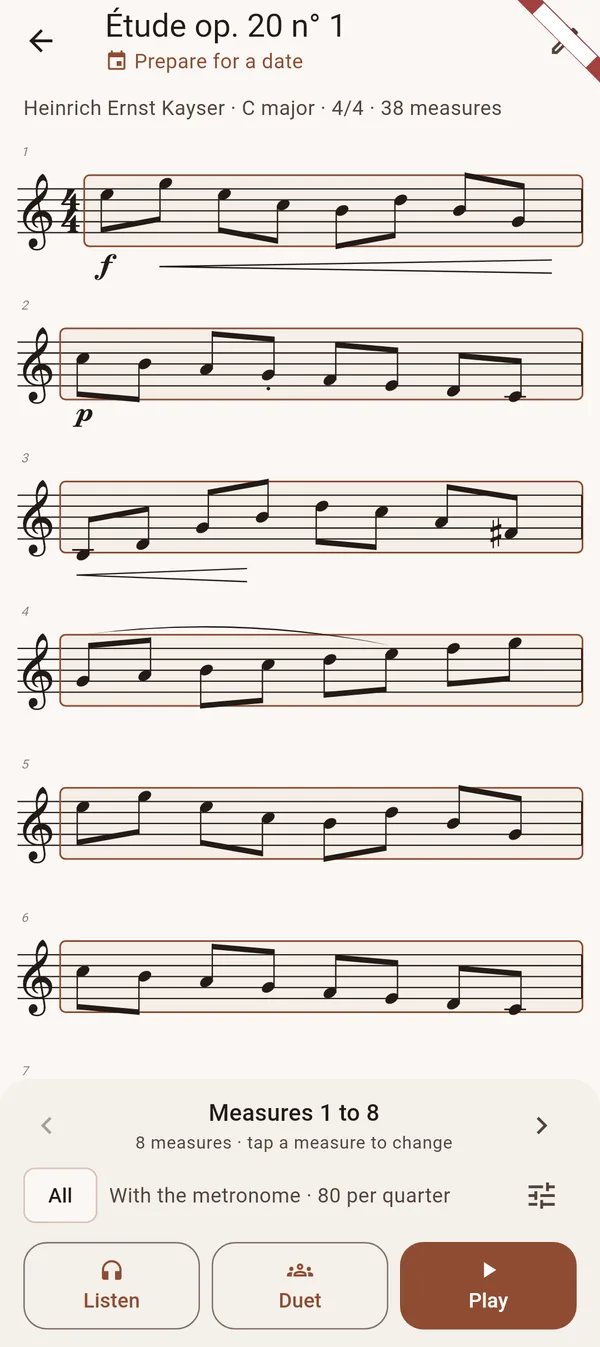
Avilo ships 23 studies from public-domain editions: Wohlfahrt op. 45, 54 and 74, Kayser op. 20, Sitt op. 32, Mazas op. 36 and Kreutzer. Each is sorted by level, with the two themes it works. Play it with the metronome or let Avilo wait for each note; after each playing every bar takes a colour, and a difficult bar becomes a short exercise.
Questions
What études should a beginner violinist play first?
Wohlfahrt op. 45, book 1, is the usual start: short studies in first position on détaché and simple slurs. Kayser op. 20 comes next.
When should I start Kreutzer?
After Kayser and Mazas, once the positions up to the fifth and shifting are secure. Dont op. 37 was written to prepare for it.
Are Wohlfahrt, Kayser and Kreutzer in the public domain?
Their music is: the composers died in the 19th century. Old editions are free, on IMSLP for instance; recent edited editions may still be under copyright.