Find third position first
In third position, the first finger stands where the third finger stood in first position: on the A string it plays D, an octave above the open D string, and the two ring together when it is in tune. Before shifting, learn to stay there: the four fingers, on two strings, then four, then scales and a simple tune in position.
One finger, with an audible glide
Shift on the first finger from first to third position, slowly, and let the glide be heard: it tells your ear and your hand the distance. Play it on all four strings, as Ševčík does in his book of shifts (op. 8), then on the second and third fingers (Hřímalý).
- Lighten the finger during the shift: it slides on the string, it does not press
- The thumb goes with the hand, not after it
- The bow keeps moving, a little lighter during the glide
Then a discreet glide
Once the distance is known, make the glide shorter and quieter, until it is “hardly perceptible”, as the editor of Ševčík's op. 8 puts it. The shift becomes faster, the arrival note stays in tune.
Changing finger during the shift
Going from the first finger in first position to the second or third in third position, the hand moves on the old finger, then the new one comes down. Many teachers, after Yankelevich, have the intermediate note played first, then shorter, then only thought:
- Intermediate note played: the old finger slides to where it would be in the new position, then the new finger drops
- Intermediate note thought: the same movement, without letting it sound
- Same note, other finger: play a note with the first finger, then the same note with the second, the hand moving up (Hřímalý no. 9)
With a string crossing, then in a scale
Then shift while changing string, arriving on the higher string, then on the lower one; shift in a scale on one string (Hřímalý); and chain shifts on a figure moved up step by step (Ševčík op. 8).
What to listen for
- Overshooting: the pitch goes past the note, then comes back. Slow down and stop the finger earlier
- Arriving flat: the hand stops too early. Check the arrival against an open string
- A late arrival: the arrival note starts after the beat. Leave earlier: the shift takes its time from the end of the note before
- Too much glide: it is heard on purpose while learning, then should become discreet
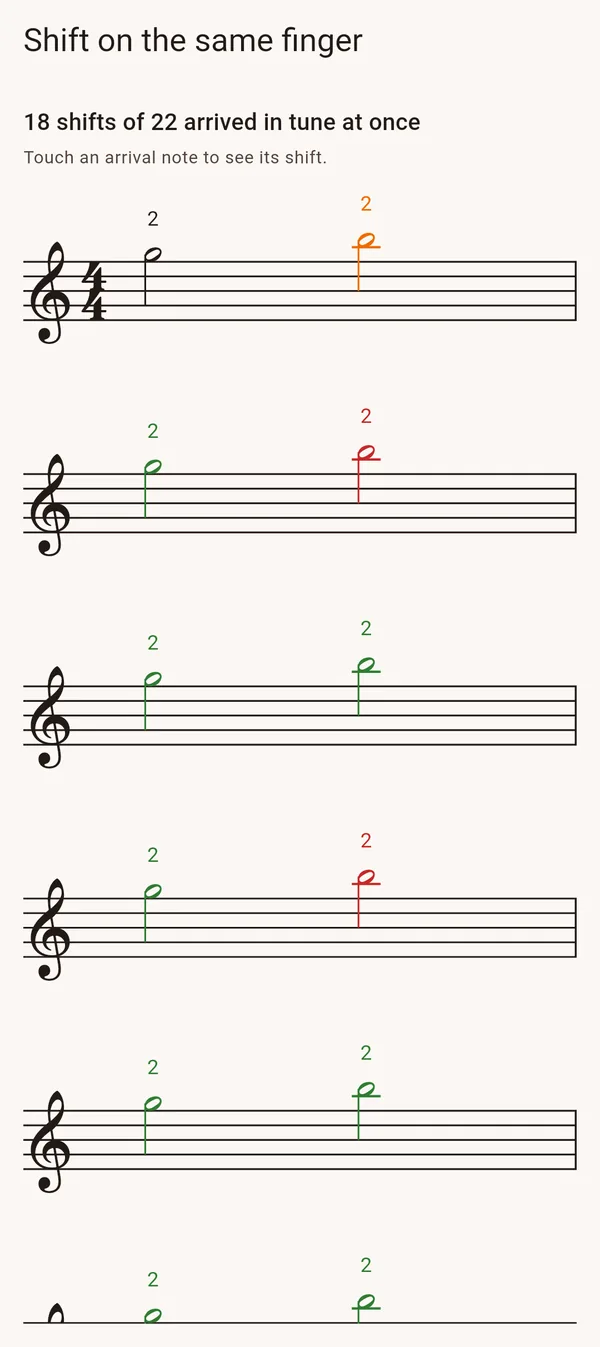
Avilo draws the pitch curve of each shift: you see the glide, how far it overshoots and how long it takes to settle.