
One arm height for each string
Each string asks for a different height of the arm. For a clean crossing, bring the arm to the right height before the note: in Ševčík's beginner's method, the bow is already placed on the next string during the rest. The smaller and closer to the string the movement, the cleaner the crossing.
- Slow crossings are made with the whole arm
- Fast crossings, with little bow, are made with the wrist and the fingers
- The bow speed and weight stay the same on both strings, so the sound stays even
The exercises in order
Each step changes one thing only. Practise each one slowly, then faster, then in rhythms.
- Open strings, D and A, two notes each, then all pairs of strings (Ševčík op. 2)
- Two notes on each string, then in eighths and in dotted rhythms (Ševčík op. 2 no. 5)
- The first finger stays down while the bow crosses, so that only the bow works (Ševčík op. 1, Schradieck book 1, section IV)
- Triplets, then sixteenths: the crossing no longer falls on the same part of the beat
- Little bow, in the middle, then at the tip and at the frog: the wrist makes the crossing
- Broken chords on three strings (Schradieck V), then bariolage, the open string alternating with a fingered one (Kreutzer)
- Broken chords on four strings (Schradieck VI), the arm moving in an arc
Common faults
- A scratch at the crossing: the arm changed height too late. Cross at the same time as you change bow
- Two strings sounding: the arm changed height too early, or went too far
- One string louder than the other: the bow got lighter on the higher string. Listen for an even volume
- Rushing: players tend to speed up in fast crossings. Check them with a metronome
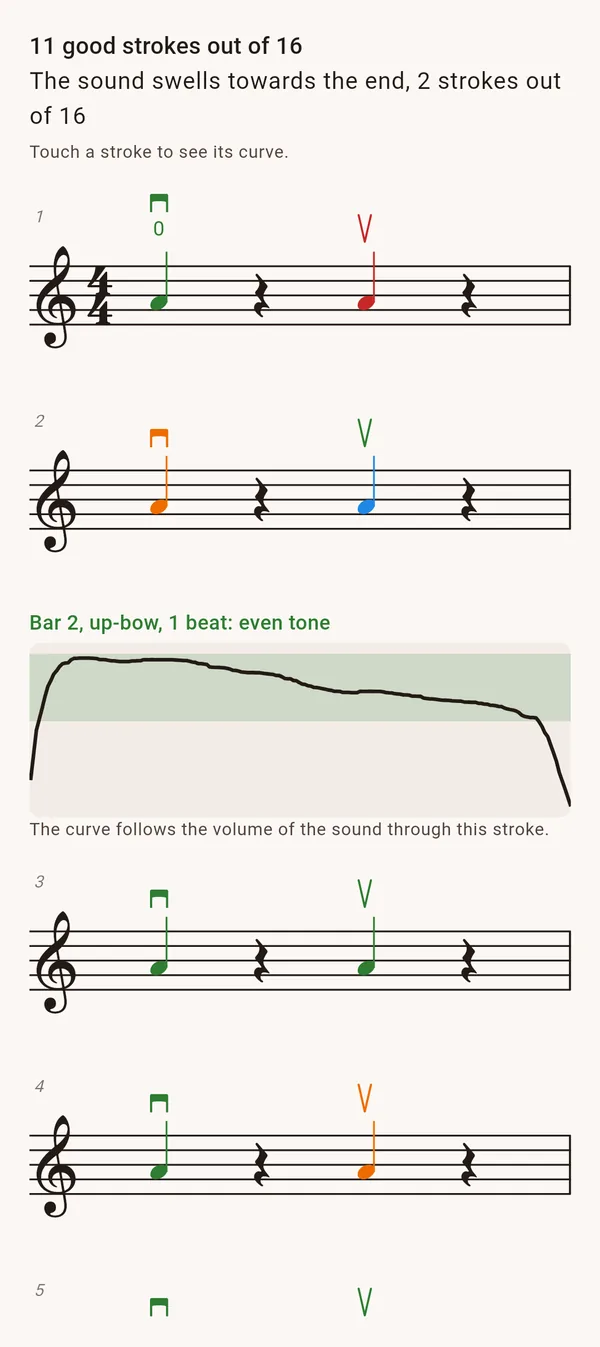
Avilo hears the start of each note against the beat and the volume of each stroke: an uneven crossing shows up as a stroke that swells or fades.
Questions
How do I stop touching other strings when I cross?
Bring the arm to the height of the new string just before the note, with a small movement. Practise on open strings, slowly, until each crossing is clean, then add speed.
Should string crossings come from the wrist or the arm?
Both: slow crossings with a lot of bow are made with the arm, fast ones with little bow with the wrist and fingers. The exercises with little bow, in the middle then at the tip and at the frog, train the second.